If you have ever pictured a future cabin near Banner Elk, you already know the view can be the easy part. The harder part is making sure the land can actually support the cabin you want to build, on the timeline and budget you expect. Before you buy, it helps to understand local rules, access, utilities, and site conditions so you can make a confident decision. Let’s dive in.
Start With Jurisdiction and Rules
A parcel described as “near Banner Elk” may not fall under just one set of local rules. Public information from Avery County and the Town of Banner Elk shows that nearby land can fall under Banner Elk, Sugar Mountain Village, Land Harbor, GGCC, or another jurisdiction.
That matters because permitting, zoning review, and site requirements can vary based on where the parcel sits. A smart first step is checking the Avery County parcel search, the town zoning map, and the county GIS information, then verifying those details against recorded deeds and plats.
Check Zoning and Public Records
Avery County’s parcel search includes zoning type and land characteristics, along with information pulled from recorded public records. The county also notes that buyers should verify details against the underlying records, which is an important reminder for any raw land purchase.
For a future cabin, you want to confirm more than just acreage. You should also confirm the parcel boundaries, road frontage, and whether the property description matches the land being marketed.
Review Covenants and Subdivision Rules
Banner Elk’s zoning permit form asks whether a parcel is part of a subdivision and whether restrictive covenants apply. That is a strong signal that you should review the plat, recorded covenants, and any HOA or community rules before closing.
Even if a lot looks perfect for a cabin, private restrictions may shape what you can build and where you can place it. Those details are easier to handle before you own the land than after.
Focus on Access Early
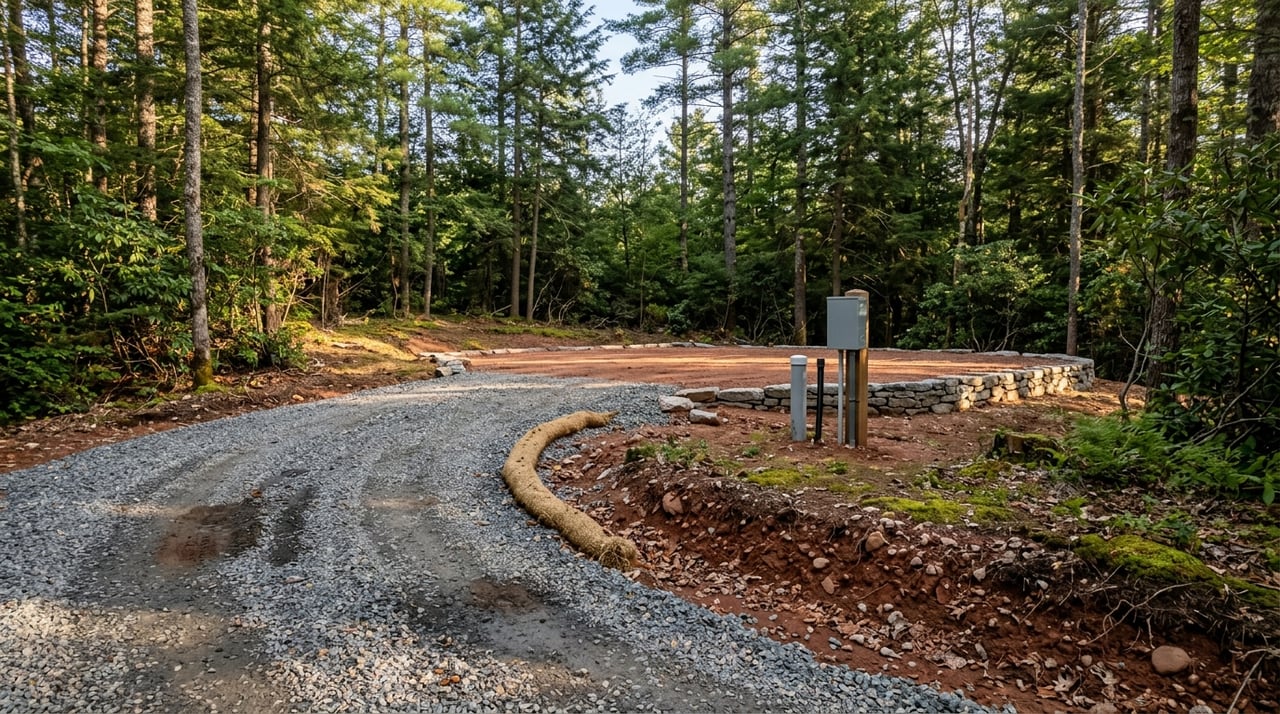
In mountain land purchases, road access can make or break a deal. A beautiful lot does not help much if the driveway is difficult to approve, costly to build, or vulnerable during heavy rain.
If your lot connects to a state-maintained road, NCDOT says a driveway permit is required for property development or altered access. The permit review covers design, drainage, traffic impacts, and motorist safety.
Know the Driveway Permit Timeline
NCDOT says there is no application fee for a driveway permit. Its FAQ also says simple requests are often processed in four weeks or less, while more complex requests can take eight weeks or more.
That timing matters if you are trying to plan site work or line up a builder. It is one more reason to look at access questions early instead of treating them as a later detail.
Understand Why Access Affects Buildability
Banner Elk’s zoning permit application asks for road connections, driveway and culvert issues, drainage, stormwater, parking, and impervious surface percentage. Its subdivision permit also asks for proposed utilities, water and sewer locations, watercourses, flood zone class, and DOT review of proposed street design.
In plain terms, access is part of the buildability review. You are not just asking whether you can reach the lot. You are asking whether the site can support a safe, workable approach for future construction and long-term use.
Verify Water, Sewer, Well, and Septic Options
Utility assumptions can create expensive surprises. The Town of Banner Elk says its water system only partially serves the town limits and a minimal area outside them.
That means you should never assume a raw land parcel near town will have municipal water or sewer available. Instead, verify utility coverage before you move forward.
Confirm Municipal Utility Service
Banner Elk’s residential water and sewer application lists separate in-town and out-of-town deposits of $75 and $150. That tells you service area and location matter.
If a parcel is outside municipal service, you should plan around private well and septic rather than expecting town hookups. For many future cabin sites, that is the practical starting point.
Learn the Avery County Septic and Well Process
Toe River Health District’s process for Avery County begins with an application and a site visit. For septic review, property lines, the house site, proposed wells, and existing site conditions must be visible.
The district says clearing the lot enough to evaluate topography, and having a backhoe or trackhoe on site, can help move the permitting process along. For wells, the application should include nearby easements, wells, springs, wetlands, contamination sources, and other site characteristics.
Budget for Local Permit Fees
Toe River Health District lists a soil evaluation fee of $480 for lots under 1,600 square feet of heated area, or $0.30 per heated square foot above that threshold. It also lists a well permit at $325, septic verification at $100, a re-site visit at $100, and well abandonment at $50.
Banner Elk’s zoning permit form shows a minimum zoning permit fee of $30 plus project-cost-based calculations. NCDOT charges no fee for a driveway permit application, but the bigger cost question is often the site work needed to make the land usable.
Study the Land, Not Just the View
Mountain acreage is rarely as simple as it looks from the roadside. Near Banner Elk, slope, drainage, sun exposure, tree cover, and usable build area can matter just as much as total acreage.
A lot may look large on paper but still offer only a limited area that works well for a cabin pad, driveway, and parking. That is why site analysis matters so much before closing.
Pay Attention to Slope and Drainage
Banner Elk’s zoning permit packet asks for a stamped site plan from a certified engineer, architect, or surveyor. It wants setbacks, road connections, culverts, contour lines, average slope, excavation areas, and retaining walls identified.
The same packet says the town’s stormwater ordinance limits impervious surface coverage and counts driveways, patios, roofs, and even gravel driveways as impervious surface. For a future cabin, that means your layout choices can affect what is realistically buildable.
Check Flood Risk and Water Features
Flood risk is worth checking even in the mountains. Banner Elk’s mapping resources link to North Carolina flood mapping, and local permit forms ask for flood zone class.
If a parcel has watercourses, low areas, or complicated topography, flood-risk review should be part of your early due diligence. This is especially important if you are comparing multiple lots that look similar at first glance.
Think About Sun and Cabin Placement
If energy efficiency or winter light matters to you, lot orientation deserves a closer look. The U.S. Department of Energy says passive solar homes work best when south-facing windows or collectors have an unobstructed view of the sun and face within 30 degrees of true south.
That does not mean every future cabin needs a solar-focused design. It does mean the best building site is not always the first clearing you notice, especially if future tree growth could limit sunlight.
Consider Radon in the Build Plan
Toe River Health District notes that Avery County is a moderate-risk area for elevated indoor radon. If you plan to build a cabin with a basement or crawlspace, that is worth keeping in mind during design and construction planning.
This does not have to be a deal breaker. It is simply one more local factor to account for as you think through the full build plan.
Plan Your Timeline Around Permits
Buying now and building later can be a smart strategy, but you still need a realistic schedule. In Avery County, permits and approvals create timing rules that can affect your next steps.
Avery County’s building permit application says work must begin within six months of permit issuance. It also says if construction stops for 12 months, the permit expires and a new permit is required.
Match Your Land Purchase to Your Build Window
If you are buying land for a cabin several years from now, it may make sense to handle your early due diligence first and time later permits carefully. Well and septic permits are typically valid for five years, according to Toe River Health District.
That can help you plan, but it also means you should avoid rushing into permits before you are ready to move forward. Good timing can save both money and frustration.
Build Your Team Early
For raw land near Banner Elk, the right professionals often matter as much as the lot itself. Local forms and permit requirements point to the value of involving a surveyor or civil engineer, a septic installer or soil evaluator, a well driller, a local builder, and a title or closing attorney.
Bringing in the right people early can help you spot issues with access, layout, drainage, and permitting before they become expensive surprises. It is one of the best ways to protect your budget and your long-term plans.
A Simple Due Diligence Checklist
Before you buy land near Banner Elk for a future cabin, make sure you can answer these questions:
- What jurisdiction governs the parcel?
- What does the plat, deed, and parcel record show?
- Are there restrictive covenants, HOA rules, or subdivision requirements?
- Does the lot have legal and practical road access?
- Will you need an NCDOT driveway permit?
- Is municipal water or sewer available, or will you need a well and septic system?
- What do the slope, drainage, and contour conditions look like?
- Are there flood-risk concerns or water features on site?
- How much usable build area do you really have?
- What site work may be needed before construction?
- When should permits be pursued based on your target build timeline?
Why Local Guidance Matters
Land near Banner Elk can be a great fit for a future cabin, but mountain property rewards careful planning. The best purchase is usually not just the prettiest tract. It is the one that fits your goals, your budget, and the real-world requirements of building in Avery County.
When you work with a local brokerage that understands raw land, access questions, and High Country market conditions, you give yourself a better chance to buy with clarity. That kind of practical guidance can make the difference between a scenic idea and a property that truly works.
If you are thinking about buying land near Banner Elk for a future cabin, Bootstrap Ventures LLC, DBA Harper Realty can help you evaluate acreage, ask the right due diligence questions, and move forward with confidence.
FAQs
What should you verify before buying land near Banner Elk for a cabin?
- You should verify jurisdiction, zoning, recorded plats, deed details, restrictive covenants, road access, utility availability, slope, drainage, flood-risk information, and whether the site can support well and septic needs.
Does land near Banner Elk always have town water and sewer?
- No. The Town of Banner Elk says its water system only partially serves the town limits and a minimal area outside them, so many parcels may need private well and septic.
Do you need a driveway permit for land near Banner Elk?
- If the lot connects to a state-maintained road, NCDOT says a driveway permit is required for property development or altered access.
How long can a driveway permit take for Avery County land?
- NCDOT says simple driveway permit requests are often processed in four weeks or less, while more complex requests can take eight weeks or more.
How long are septic and well permits valid in Avery County?
- Toe River Health District says well and septic permits are typically valid for five years.
What site conditions matter most for a future cabin near Banner Elk?
- Key conditions include slope, contour lines, drainage, culvert needs, impervious surface limits, usable build area, flood-risk factors, and access for future construction.
When do Avery County building permits expire?
- Avery County’s building permit application says work must begin within six months of permit issuance, and if construction stops for 12 months the permit expires and a new permit is required.