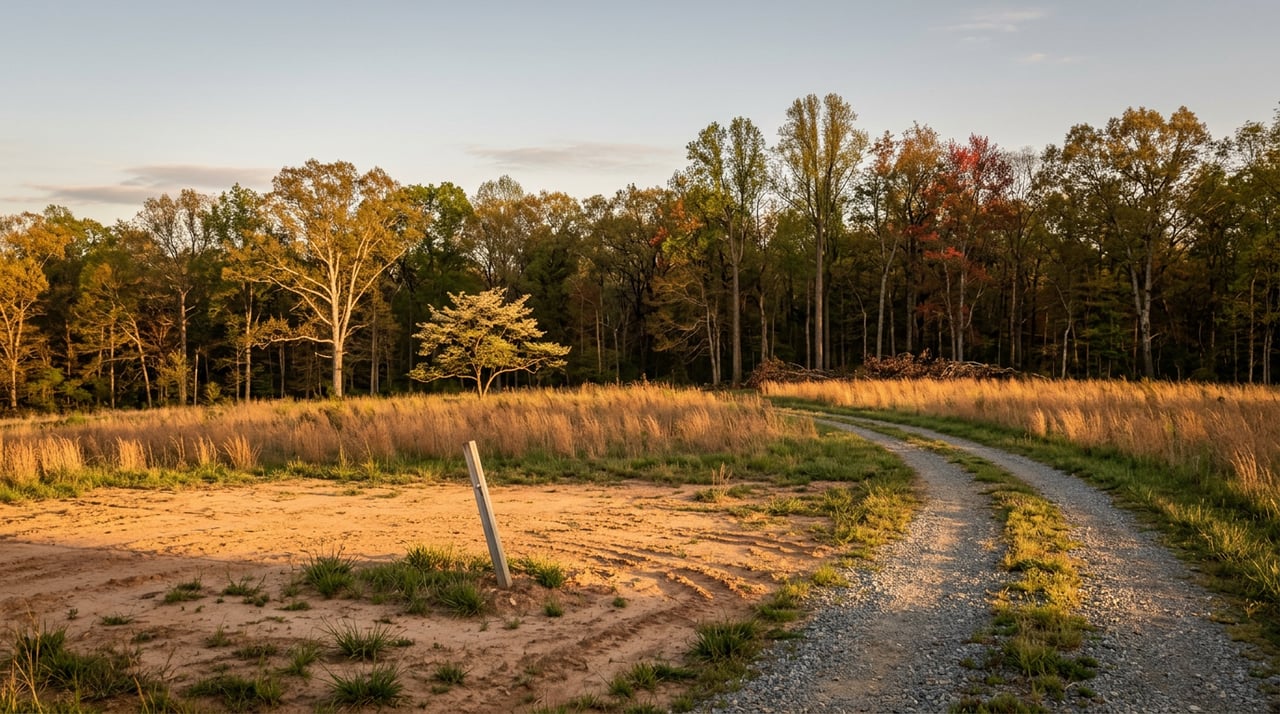
Two land listings, same county, same week. One sits off toward the Catawba River in the western half of Alexander County: fifty-some acres of rolling pasture and timber, no house, priced well under half a million dollars. The other sits a few miles outside Hiddenite: five acres, some road frontage, a creek running through it, priced almost as high as the fifty-acre tract. Per acre, the small lot costs roughly half again as much as the big one.
Buyers assume that's a mistake, or a seller's fantasy. It isn't. It's how two different land markets happen to share one county line.
The county-wide number and the Hiddenite number aren't measuring the same thing
Alexander County's land market, taken as a whole, skews large. Recent inventory tracked across the county put the average listing at around 108 acres, priced near $1.18 million, which works out to a median of roughly $13,000 per acre. Taylorsville, the county seat, carries the largest share of that acreage. Most of it is timber, pasture, or recreational land bought in bulk rather than land bought to build one house on.
Land specifically around Hiddenite tells a different story. A recent snapshot of listings in and around the community showed an average asking price near $525,000 across parcels totaling a few hundred acres, which puts the average cost per acre closer to $20,300. That's roughly 56 percent higher than the county median. Divide the average price by the average per-acre figure and the implied lot size comes out to around 26 acres, a fraction of the county's typical 108-acre tract.
| County-wide average | Hiddenite-area average | |
|---|---|---|
| Typical listing price | ~$1,184,815 | ~$525,591 |
| Price per acre | ~$13,008 | ~$20,318 |
| Typical tract size | ~108 acres | ~26 acres (implied) |
Neither number is wrong. They're describing two different products that happen to sit in the same county GIS database.
The size discount is doing most of the work
Large acreage sells cheaper per acre for a mundane reason: most of it isn't buildable footprint, and it doesn't need to be. A hundred-acre timber or pasture tract might carry one home site and ninety-nine acres of land whose value is in the trees, the hunting rights, or the eventual resale to another large-acreage buyer. Nobody is paying homesite prices for the back forty.
Small parcels don't get that discount. A five-acre or ten-acre lot with road frontage is, functionally, a home site with a little land attached, and it gets priced against other home sites rather than against raw acreage. That alone would explain some of the Hiddenite premium even if the community had nothing else going for it.
What Hiddenite has going for it
It has something else going for it. Hiddenite is home to Emerald Hollow Mine, which the North Carolina Department of Natural and Cultural Resources describes as the only emerald mine in the United States that invites the public to search for gemstones. That single fact turns a farming community into a tourist stop, and tourist stops generate foot traffic, small commercial demand, and a reason for a road-frontage parcel near town to be worth more than an equivalent parcel a few miles further out.
The rest of the small-town infrastructure backs that up. The Hiddenite Arts & Heritage Center operates out of the historic James Paul Lucas Mansion, which also houses the Alexander County Visitor Center. Rocky Face Park draws hikers and climbers. The community's annual Celebration of the Arts, now in its fifth decade, has been described by local accounts as drawing crowds in the range of 15,000 visitors over its run. None of that shows up in a per-acre spreadsheet, but it's the reason a five-acre lot near Hiddenite competes in a different buyer pool than a five-acre lot elsewhere in the county.
The permit that decides whether any of this matters
Here's the part that catches land buyers off guard, and it has nothing to do with price.
None of these acreage numbers, county-wide or Hiddenite-specific, tell you whether a given tract can actually support a house. Most of rural Alexander County sits outside municipal water and sewer service, which means a well and a septic system, and neither is automatic.
Alexander County's Environmental Health division handles this through two possible approvals. An Improvement Permit evaluates whether the soil on a lot is suitable for a septic system and, if the applicant provides a surveyor's plat, that permit doesn't expire as long as the lot's conditions don't change. If the applicant submits a site plan instead of a surveyed plat, the permit is only good for five years. An Authorization to Construct goes a step further and actually authorizes a septic contractor to install a system, also valid for five years. Critically, if the lot will need a well, the buyer has to apply for the well permit at the same time as the septic permit, so the county can determine the well site during the same site visit.
Skip that step and a beautiful, well-priced tract can turn out to be unbuildable, or buildable only with a far more expensive engineered system. North Carolina overhauled its statewide soil evaluation rules effective January 1, 2024, the first major rewrite in more than three decades, which means even an older soil report on a listing sheet may reflect standards that no longer apply.
The price per acre tells you what the market thinks the dirt is worth. The permit tells you what you can actually do with it.
Zoning adds a second layer worth checking before you make an offer
Alexander County's own 2045 Comprehensive Plan, adopted in April 2024, sorts future land use into three broad categories: an Urban Services Area near existing infrastructure, a Rural/Urban Transition Area, and a Rural/Agricultural Area that covers most of the county's acreage. Zoning districts underneath that plan range from straightforward residential tiers to R2R, which allows rural residential use alongside some light commercial and industrial activity. That distinction matters for a Hiddenite buyer who might want to combine a home with a small business, a workshop, or a gem-and-mineral retail operation near the mine's tourist traffic. It's worth confirming a parcel's zoning on the county's GIS site before assuming a use is allowed, since a rezoning petition carries a $500 filing fee and a public notice process rather than a quick administrative fix.
What this means if you're comparing tracts
The county's home resale market gives a useful reminder that land and houses don't always move together. As of August 2025, the median home sale price across Alexander County sat around $270,000, down slightly from a year earlier, with homes taking an average of 93 days to sell compared to 39 days the year before. That's a market cooling on the house side. Raw acreage, especially acreage tied to a specific draw like Hiddenite's tourism economy, doesn't necessarily track that same curve, because the buyer isn't purchasing a finished product to resell quickly. They're often buying a future home site, and their timeline is measured in permits and construction seasons rather than days on market.
The practical takeaway for anyone comparing tracts across the county: don't average the county's price per acre against a Hiddenite listing and assume one is overpriced. Ask what the land is actually for. If it's bulk acreage for timber or recreation, the county's broader numbers are the right comparison. If it's a home site near a town with its own draw, compare it against other small, road-fronted parcels in that same micro-market, and get the soil and well questions answered before the due diligence period runs out.
A few questions worth asking before you write an offer
Does the listing include a current Improvement Permit or Authorization to Construct, and was it issued under the post-2024 soil evaluation rules? An older report may not reflect current standards.
If the lot needs a well, has that permit been applied for alongside the septic permit? The county requires both to be filed together so the well site can be determined during the same evaluation.
What zoning district is the parcel in, and does that district allow the use you have in mind? R2R and similar rural-residential districts allow more flexibility than straight residential zoning, but it's confirmed on the county GIS map, not assumed from the listing description.
Land math in Alexander County only looks confusing until you separate the two markets hiding inside one county average. If you're comparing acreage near Hiddenite against a larger tract elsewhere in the county, or you just want someone who knows which permits actually matter before you write an offer, Harper Realty can walk the parcel with you and help you request a free home valuation before you commit to a price per acre that may not mean what you think it means.